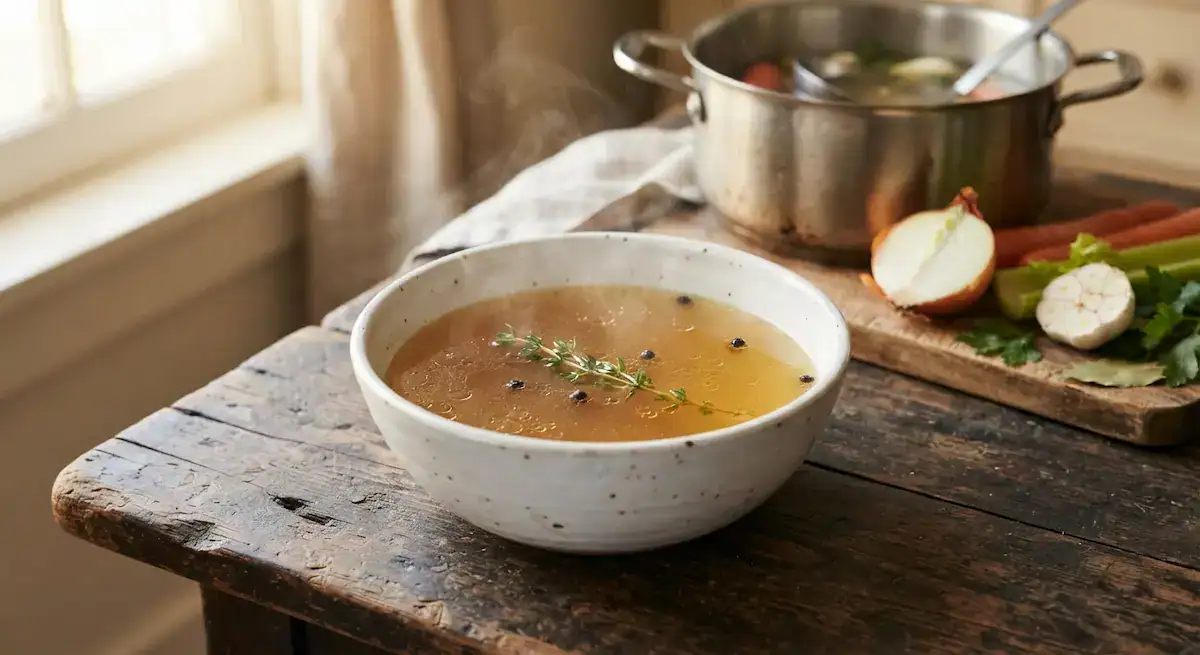
Chicken Stock Recipe: How to Get Deep, Flavorful Stock (and Know Exactly What’s in It)
I still remember the day I flipped a carton of store-bought stock over and actually read the label. The sodium number stopped me mid-aisle. A cup of pale golden liquid seems like a small thing, but it sits underneath nearly every soup, grain and sauce you’ll cook this week, and whatever is in it ends up in all of them. That’s why a reliable chicken stock recipe now lives on permanent rotation in my kitchen, and why I think it belongs in yours.
This chicken stock recipe asks for a few hours but very little attention. You get rich flavor, real gelatin and complete control over the salt. Along the way I’ll explain why each step works, because once you understand the pot, you’ll never follow a recipe blindly again.
Table of Contents
Doctor’s Note: Why a Plain Pot of Stock Belongs in a Healthy Kitchen
The medical case for this chicken stock recipe is mostly about what it leaves out. When you make stock at home and add no salt, you decide how much sodium reaches your plate. The Dietary Guidelines for Americans advise keeping sodium under 2,300 milligrams a day, and the American Heart Association recommends an ideal limit of 1,500 milligrams for most adults. Those targets are easy to overshoot when broth, canned soup and sauces each contribute quietly. Many packaged broths carry a sizable slice of that daily budget in a single cup, so read labels and compare.
Stock is also warm, hydrating and easy to sip when you have no appetite. What it isn’t is a cure for anything. I’ll get into that in more detail a little later.
The Pot as a Patient: What Stock Actually Is
Extraction, Not Boiling
Think of stock as a slow extraction. Hot water gradually pulls flavor compounds, minerals and collagen out of the bones. Collagen is the connective tissue in skin, tendons and cartilage. Under long, gentle heat it breaks down into gelatin, which is why a good stock turns wobbly in the fridge. If you’ve ever spent time in an anatomy lab, this will feel oddly familiar: you’re dissolving the same tissues you’d study on a dissection table into something you can sip.
That gelatin gives stock its silky body. It’s also why wings, backs and feet beat lean breast meat for this job.
Stock, Broth, Bone Broth: The Practical Differences
These words overlap in everyday use, and there’s no single strict definition, but here’s how I think about them:
- Stock: mostly bones, a longer simmer, usually unseasoned. It’s a base for other dishes.
- Broth: more meat, a shorter simmer, usually seasoned. It’s meant for sipping.
- Bone broth: bones simmered longer still, often seasoned and sipped.
The Ingredient Chart for This Chicken Stock Recipe

| Ingredient | Amount | What it does |
|---|---|---|
| Chicken carcasses, wings or backs | About 3–4 pounds (roughly 1.5–2 kilograms) | Gelatin, body, base flavor |
| Chicken feet (optional) | 4 to 6 | Extra collagen for a firmer gel |
| Yellow onion, halved, skin on | 1 large | Sweetness and golden color |
| Carrots, roughly chopped | 2 | Gentle sweetness |
| Celery ribs | 2 | Savory, herbal background |
| Garlic, halved crosswise | 1 head | Depth |
| Bay leaf | 1 | Aroma |
| Black peppercorns | 8 to 10 | Mild warmth without salt |
| Parsley stems and thyme | small handful | Fresh top notes |
| Apple cider vinegar (optional) | 1 tbsp | Mild acidity |
| Cold water | about 4 quarts (16 cups) | The solvent |
| Salt | none in the pot | Season the finished dish instead |
Yield: about 10 to 12 cups.
Simmer time: 4 to 6 hours.
The vinegar’s benefit is modest and debated, so treat it as optional rather than essential.
Making the Stock, Round by Round
I treat the pot like a patient on the ward. Rather than a flat list of steps, you check its vital signs on scheduled rounds. This chicken stock recipe is forgiving as long as you keep an eye on the pulse.
Round 0: Admission (Prep)
- Optional roast: spread the bones on a sheet pan and roast at 425°F (220°C) for 30 to 40 minutes. Browning adds a deeper, roasted flavor.
- Put the bones in a large stockpot and cover with cold water, just enough to submerge them.
- Set the pot over medium heat and let it slowly reach a gentle simmer.
Round 1: The First Hour
Vital sign: foam. Gray scum will gather at the surface as proteins coagulate. Skim it off during the first 20 to 30 minutes, then add the onion, carrot, celery, garlic, bay leaf and peppercorns.
Round 2: Hours Two to Four
Vital sign: the pulse. You want a lazy bubble breaking the surface every few seconds, a resting heart rate. A rolling boil is tachycardia: it churns fat into the liquid and leaves you with a cloudy, greasy stock. Keep the lid ajar and top up with hot water if the bones poke out.
Round 3: Hours Four to Six
Vital sign: gel. Spoon a little stock onto a cold plate and chill it for a minute. It should turn slightly jiggly. Add the parsley and thyme for the last 20 minutes, then strain through a fine sieve. Resist pressing on the solids, because that pushes cloudy particles through.
Five Levers That Change Everything in Any Chicken Stock Recipe
Lever 1: The Bones You Choose
Wings, Backs and Feet
These are collagen-rich and cheap. Feet look alarming, but they’re the fastest route to a stock that gels.
A Leftover Roast Carcass
Perfectly usable. Expect a lighter, less gelatinous result, and simmer for less time, about 2 to 3 hours.
Lever 2: The Water Ratio
Cover the bones and no more. Extra water doesn’t extract extra flavor; it dilutes what’s there.
Lever 3: Heat Discipline
Keep the surface barely moving. Gentle heat protects clarity and keeps fat where it belongs, on top, where you can lift it off later.
Lever 4: Aromatic Timing
Onion, carrot and celery can go in early. Delicate herbs like parsley belong at the end so their brightness survives.
Lever 5: Salt Last
Season the dish, not the stock. This keeps the stock versatile, and it keeps your sodium in your hands.
Reading the Pot: Troubleshooting
| Symptom | Likely cause | Fix |
|---|---|---|
| Cloudy | Boiled too hard | Hold a bare simmer; skim early |
| Greasy | Fat left in | Chill it and lift off the solid layer |
| Weak flavor | Too much water or too short a simmer | Reduce after straining |
| Won’t gel | Too few collagen-rich parts | Add wings or feet next time |
| Bitter | Over-browned aromatics | Roast to golden, not dark |
Nutrition Facts (Per 1-Cup Serving)
Numbers vary with the bones you use and how thoroughly you skim the fat, so treat this chicken stock recipe’s nutrition as an approximation.
| Nutrient | Approximate amount |
|---|---|
| Calories | 15 to 40 |
| Protein | 2 to 4 g |
| Carbohydrates | under 2 g |
| Fiber | 0 g |
| Sugar | under 1 g |
| Sodium (no added salt) | 50 to 100 mg |
For exact values based on your own ingredients, enter them into USDA FoodData Central.
What the Research Shows—and What It Doesn’t
What Holds Up
- Sodium control. Homemade unsalted stock lets you set the salt yourself, as covered above.
- Comfort and hydration during a cold. A small, classic body of research exists here. A 1978 study in Chest by Saketkhoo and colleagues looked at nasal mucus movement after hot chicken soup, and a 2000 Chest paper by Rennard and colleagues found chicken soup affected neutrophil migration in the lab. These are small or laboratory studies. They’re interesting, but they don’t prove that chicken stock treats a cold.
What’s Overhyped
- “The collagen in stock rebuilds your joints and skin.” Dietary collagen is broken down during digestion into amino acids and small peptides, just like other proteins. Whether collagen supplements help is a separate research question, and the evidence is still developing.
- “Detox” and “gut-healing” claims. I haven’t seen solid evidence for these, so I won’t promise them.
Who Should Be Careful
- Gout: meat-based liquids contain purines, so ask your clinician.
- Kidney disease or fluid restrictions: talk to your care team before adding stock regularly.
- Histamine sensitivity: long-simmered, long-stored animal foods can be an issue for some people.
- Quality of bones: one small 2013 analysis in Medical Hypotheses reported lead in some homemade broths. It’s limited evidence, but it’s one more reason to buy bones from a source you trust.
Diets This Stock Fits
- Low-sodium: yes, provided you add no salt.
- Diabetic-friendly: negligible carbohydrate.
- Heart-healthy: when skimmed of fat and unsalted.
- Gluten-free, dairy-free, low-carb, paleo and Whole30-friendly.
- Anti-inflammatory eating patterns: it fits as a whole-food base, though I’m not claiming the stock itself reduces inflammation.
- High-protein: only modestly. Stock is not a major protein source.
Cool It Fast, Store It Right
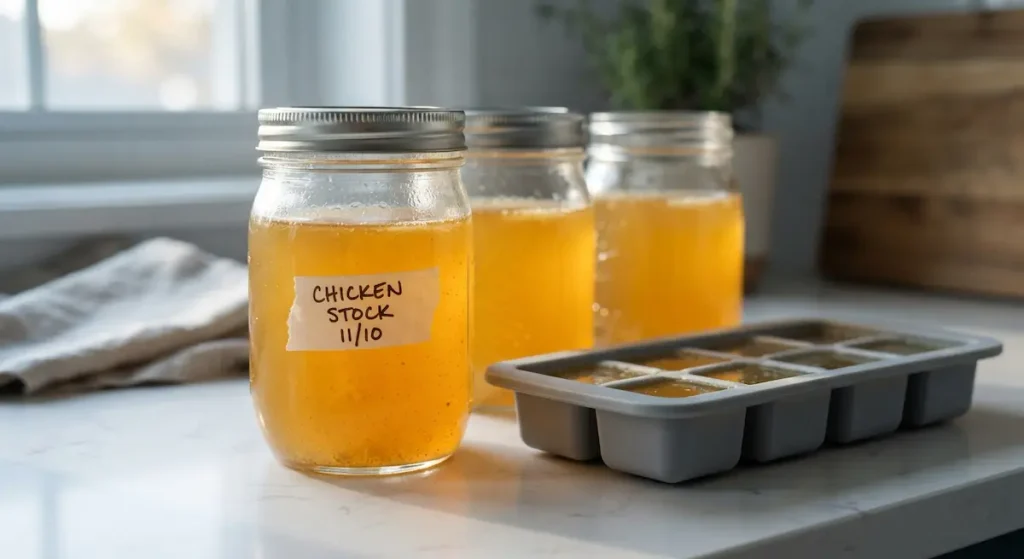
A big pot of hot liquid cools slowly, and that slow cooling is exactly what bacteria like Clostridium perfringens enjoy. The CDC and USDA advise refrigerating cooked food within two hours, and the “danger zone” runs from 40 to 140°F.
- Set the pot in an ice bath, or divide the stock into shallow containers.
- Refrigerate once it stops steaming.
- Lift off the fat layer after it solidifies.
Refrigerated stock keeps about three to four days, according to USDA guidance. For longer storage, freeze it. Ice cube trays are ideal for a flavor boost, and one-cup portions suit soups and grains. This stock is also the natural base for my Greek Chicken Lemon Rice Soup.
FAQ
What’s the difference between a chicken stock recipe and a broth recipe?
Stock leans on bones and gelatin with a longer, unseasoned simmer. Broth leans on meat and is usually seasoned for sipping.
Can I make this chicken stock recipe with a rotisserie carcass?
Yes. Simmer for a shorter time and expect a lighter result.
Why is my stock cloudy?
Almost always because it boiled. Keep to a bare simmer and skim early.
Does chicken stock cure a cold or heal your gut?
No. It’s comforting and hydrating, and some small studies are intriguing, but no chicken stock recipe is a cure. Treat it as good food, not medicine.
Is homemade stock healthier than store-bought?
Mostly because of sodium and additives, which you control when you make it yourself.
Can I use a slow cooker?
Yes. Roughly 8 to 10 hours on low works well, with the same skimming and straining.
A Note on Medical Information
The information in this article is provided for general educational purposes and does not constitute medical advice. It doesn’t replace guidance from a qualified healthcare provider. If you have a medical condition, follow a restricted diet, or are pregnant, consult your doctor or a registered dietitian before changing what you eat.
Conclusion
Go back to that carton on the shelf and the pot on your stove. One is a mystery you rent; the other is a foundation you understand. With gentle heat, no salt in the pot and a quick cool-down, this chicken stock recipe hands you rich flavor and full control.
Your turn: make a batch this weekend, freeze it in portions, and tell me in the comments how it went. If you want more recipes built on this food-first approach, subscribe to the DocCuisine newsletter, and share this chicken stock recipe with someone who needs a better base for their soup.
Food first, medicine second.
What Readers Think :
There are no reviews yet. Be the first one to write one.