
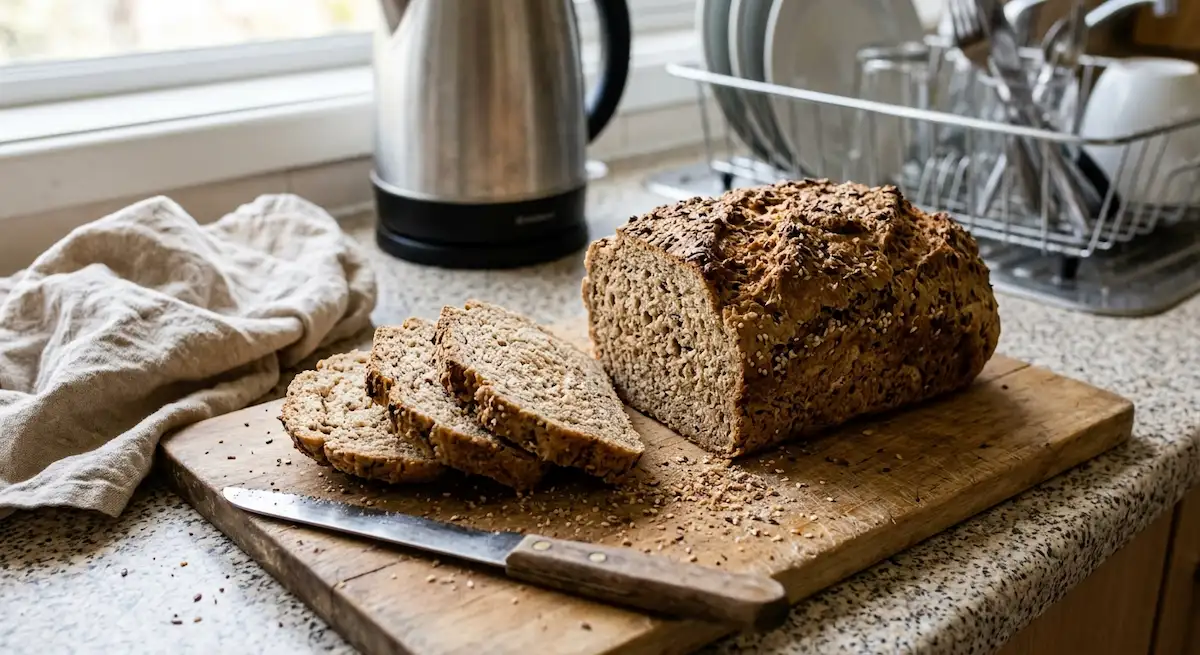
Whole Wheat Flour Bread Recipe: A Simple Recipe for Beginners
Food first, medicine second.
In the middle of a brutal exam week, I baked a loaf that could have doubled as a paperweight. It was dense, faintly bitter, and it crumbled the second the knife touched it. I blamed the recipe, then the oven, then the yeast, and only much later the real culprit: I had treated whole wheat flour as if it were white flour in a darker coat.
That heavy loaf is the reason this whole wheat flour bread recipe exists. It is a soft, springy, properly sliceable whole grain bread recipe built on 100% whole wheat flour, a spoonful of olive oil, a little maple syrup, and no more salt than the dough truly needs. I bake it most weeks now, and over the next few minutes you will learn not only how to make it, but why whole wheat bread behaves so differently in the bowl, and why that difference matters for your heart.
This loaf lives in our Heart Health Recipes category, alongside other dishes where the ingredient list quietly does some work for your cardiovascular system.
This Whole Wheat Flour Bread Recipe is designed to help you make a soft, flavorful loaf with simple ingredients and an easy-to-follow method.
Table of Contents
The Medical Angle: Why a Humble Loaf Earns a Place in a Heart-Healthy Kitchen
In plain terms: Turning wheat into white flour strips away the bran and the germ, and most of the fiber goes with them. Large population studies link eating whole grains in place of refined grains with better heart health. That is an association, not a guarantee, and no single food protects a heart on its own. Think of this loaf as one small, repeatable swap inside a bigger pattern: more plants, more fiber, fewer refined starches, less salt, less added sugar.
I like that framing because it is honest, and because it is doable. You do not need a flawless diet to benefit from a swap you genuinely enjoy on an ordinary Tuesday morning. A slice of this whole wheat flour bread recipe, topped with mashed avocado or a spoonful of hummus, takes the place of a refined-grain breakfast without feeling like a sacrifice.
Dissecting the Kernel: Why Whole Wheat Bread Is Not Just Darker White Bread
Anatomy is the subject I spend my days on, so I tend to picture a wheat kernel as a tiny organism with three tissue layers. Each layer changes what happens in your dough and, later, in your body.
The bran: armor and most of the fiber
The outer coat holds the bulk of the fiber, along with minerals such as magnesium. In dough, though, bran is a mixed blessing. Its particles are thirsty, soaking up water far more slowly than starch does, and their sharp edges can nick the gluten strands that trap gas. That is why careless whole wheat loaves bake up squat and crumbly.
The germ: the embryo, rich in oil
The germ carries natural oils and vitamin E, which is wonderful nutritionally and a nuisance in the pantry. Those oils go rancid over time, giving old whole wheat flour a bitter, paint-like smell. If you do not bake often, keep the bag in the fridge or freezer.
The endosperm: the starch reserve
This is all that white flour keeps: mostly starch and protein, soft and mild, easy to turn into something pillowy. Whole wheat flour keeps all three layers, which is the whole point, and also the whole challenge.
Numbers make the difference concrete. USDA FoodData Central lists roughly 10 to 12 grams of fiber per 100 grams of whole wheat flour, against under 3 grams for all-purpose white flour, so about fourtimes as much, depending on which source you consult. Any whole wheat flour bread recipe worth your oven has to respect that difference, which is why the method below starts with a rest instead of a knead.
What the Research Says About Whole Grains and Your Heart
Bread is an easy place to overpromise, so let me separate what looks solid from what remains uncertain.
What looks solid
In a 2015 paper in JAMA Internal Medicine, Hongyu Wu and colleagues at Harvard pooled data from more than 110,000 nurses and health professionals followed for roughly 25 years. For each extra 28-gram daily serving of whole grains, they estimated about 5% lower overall mortality and about 9% lower cardiovascular mortality. They found no link with cancer deaths (study abstract). Another Harvard analysis, published the same year in the Journal of the American College of Cardiology (Li et al.), found a link between substituting whole grains for a small percentage of daily calories from refined grains and added sugars and a reduced risk of coronary heart disease.
Official guidance points the same way. The American Heart Association and the US Dietary Guidelines both advise making at least half of the grains you eat whole grains.
What is still uncertain
These are observational studies. People who eat more whole grains also tend to be more active and less likely to smoke, and although researchers adjust for those habits, they cannot erase them entirely. Nobody knows the ideal dose, and wheat fiber is mostly the insoluble kind, so do not expect the cholesterol-lowering reputation of oats from bread alone.
Here is a small piece of arithmetic of my own, not a study result: one slice of this loaf contains about 32 grams of whole wheat flour, which lands close to the 28-gram serving those researchers used. Three or four slices a week is a realistic habit, not a miracle.
Ingredients for This Whole Wheat Flour Bread Recipe
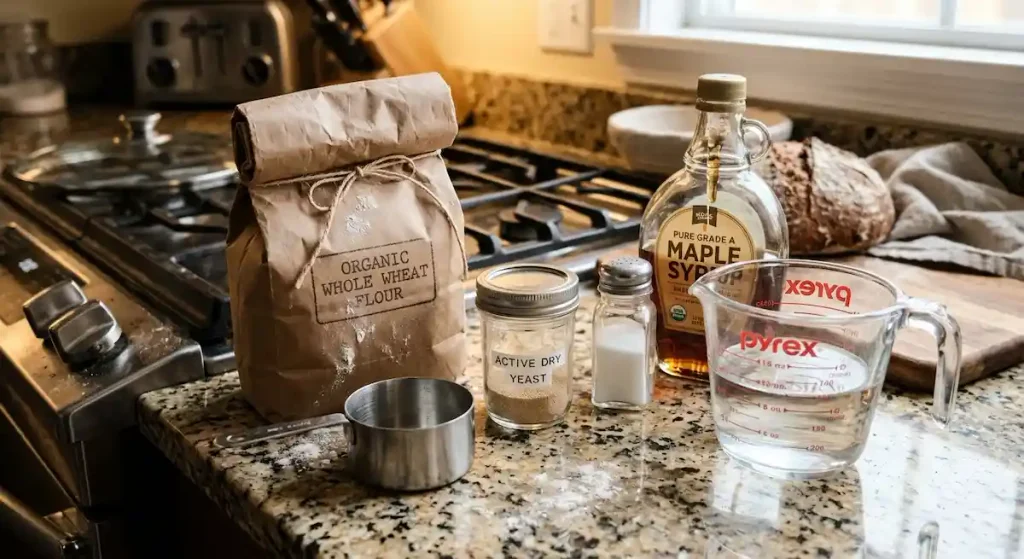
This makes one 9 x 5 inch (23 x 13 cm) loaf, about 12 slices.
Everything you need for this Whole Wheat Flour Bread Recipe is simple and easy to find, with each ingredient playing an important role in the final texture.
| Ingredient | Amount | What it does |
|---|---|---|
| 100% whole wheat flour | 3¼ cups (390 g) | Structure, flavor, and all of the fiber |
| Lukewarm water (about 95–105°F / 35–40°C) | 1⅓ cups (320 ml) | Softens the bran and wakes up the yeast |
| Instant yeast | 2¼ tsp (7 g) | Lift |
| Olive oil | 1 tbsp (15 ml) | Tenderness, with no butter needed |
| Maple syrup (or date syrup) | 1 tbsp (15 ml) | Feeds the yeast and softens bran’s bitter edge |
| Fine salt | 1 tsp (6 g) | Flavor and gluten strength |
A few notes before you start
- Weigh the flour if you can. Scooping a cup straight from the bag packs it down, and a heavy hand is the quickest route to a dry loaf.
- The dough will look too wet at first. That is the bran drinking slowly. It tightens up during the rest, so resist the urge to add more flour.
- Skip honey if you want a vegan loaf. Maple or date syrup does the same job.
- Do not drop the salt entirely. One teaspoon across twelve slices keeps sodium modest, and salt also helps the gluten hold together.
Nutrition Facts for This Whole Wheat Flour Bread Recipe (Per Slice)
| Per slice (1 of 12) | Approximate amount |
|---|---|
| Calories | 125 kcal |
| Protein | 4.5 g |
| Carbohydrates | 24 g |
| Fiber | 4 g |
| Sugar | 1 g |
| Total fat | 2 g |
| Sodium | 195 mg |
These figures are estimates built from USDA FoodData Central values for the ingredients above. Your flour brand and slice thickness will move them a little. Bread contains carbohydrate, so if you are managing your blood sugar, count it as part of the meal. This loaf is higher in fiber than white bread, but it is not a free food.
Step-by-Step Whole Grain Bread Recipe
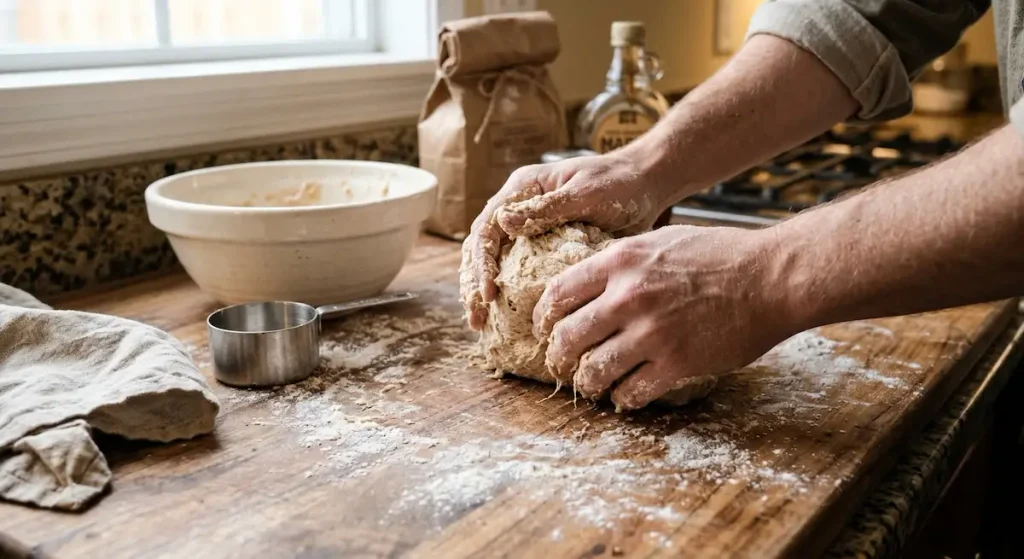
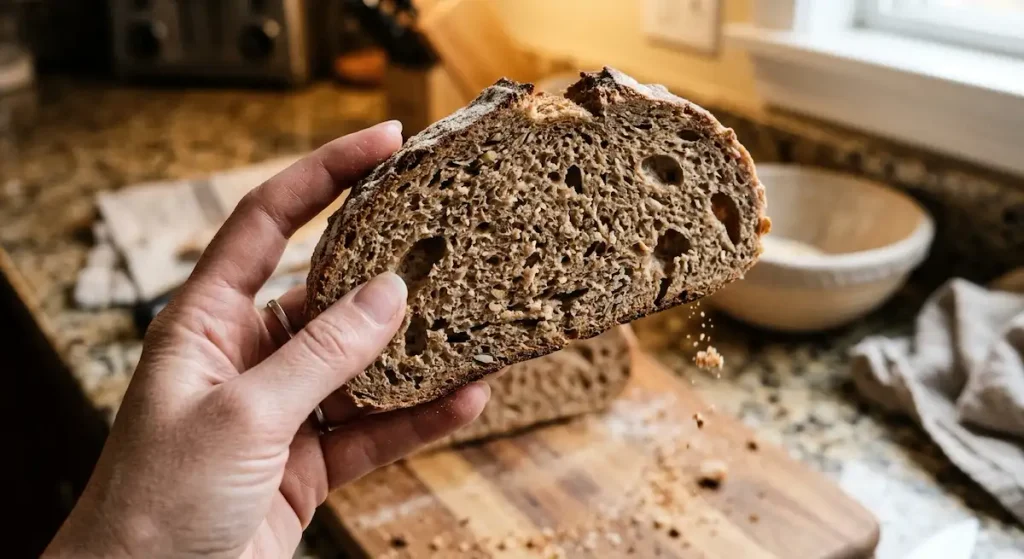
Follow this Whole Wheat Flour Bread Recipe step by step to get a tender, well-risen loaf with a soft crumb and delicious whole wheat flavor.
Step 1: Soak the flour
Stir the flour and water together until no dry patches remain. Cover and leave it for 30 minutes. This pause lets the bran soften, which protects the gluten later. Do not skip it.
Step 2: Add the rest
Sprinkle on the yeast and salt, then add the maple syrup and olive oil. Knead for 8 to 10 minutes by hand, or 6 to 8 minutes in a stand mixer on medium-low.
Step 3: Check the dough
It should feel tacky but not sticky, smooth, and slightly springy.
How to tell it is ready
Whole wheat dough rarely gives a perfect windowpane, so use a gentler test: press a fingertip in, and the dent should spring back slowly rather than snap back or stay put.
Step 4: Let it rise
Place the dough in a lightly oiled bowl, cover, and rest in a warm spot for 60 to 75 minutes, until nearly doubled.
Step 5: Shape it
Flatten the dough into a rectangle, roll it up snugly like a sleeping bag, pinch the seam closed, and settle it seam-side down in a greased loaf pan.
Step 6: Rise again
Cover and rest for 30 to 45 minutes, until the dough crests about an inch (2.5 cm) above the rim. Heat the oven to 375°F (190°C) for the final 15 minutes.
Step 7: Bake
Bake for 35 to 40 minutes. If the top darkens fast, tent it with foil after 20 minutes. The loaf is done at an internal temperature of about 200°F (93°C), or when the base sounds hollow when tapped.
Step 8: Cool completely
Turn it out onto a rack and wait at least an hour. The crumb is still setting inside, and slicing early gives a gummy middle.
Why Your Whole Wheat Loaf Turned Out Dense, and How to Fix It
Every whole wheat flour bread recipe punishes shortcuts, so most problems trace back to a handful of causes.
- Dense and heavy: too little water, too little rising time, or tired yeast. Weigh the flour, extend the second rise, and check your yeast’s date.
- Dry, crumbly slices: usually too much flour, often because it was scooped rather than weighed. A scale solves it.
- Bitter or paint-like taste: stale flour with rancid germ oil. Smell the bag before you bake.
- Collapsed top: over-proofed dough. Next time, bake when it just clears the rim.
- Gummy slices: cut too soon. Be patient.
Diets This Loaf Fits
Made exactly as written, this loaf is:
- Vegetarian and vegan (no milk, butter, or honey)
- Dairy-free and nut-free
- Higher in fiber than white bread
- A true whole-grain bread, since the only flour is 100% whole wheat
- Easy to fit into a heart-healthy eating pattern, thanks to low added salt and sugar
How I Like to Eat It
Toasted, with mashed avocado and a squeeze of lemon, is my weekday default. On busy days it becomes a sandwich, and our Egg Salad with Greek Yogurt is a natural filling. Other good pairings are hummus with sliced cucumber, a thin spread of natural nut butter with banana, or a bowl of lentil soup on the side. Notice the pattern: each one adds plants, protein, or healthy fats to the fiber already in the bread.
Storing Your Whole Grain Loaf
Store it in a bread bag or covered container at room temperature for up to three days. For longer storage, slice it once it has cooled and freeze it in a sealed bag for up to three months. Toast slices straight from the freezer. Because there are no preservatives, it will go stale faster than a supermarket loaf, and that is a perfectly good sign.
Frequently Asked Questions About Whole Wheat Bread
How is this whole wheat flour bread recipe different from a store-bought loaf?
It has six ingredients and you control every one. Many commercial loaves contain added sugars, dough conditioners, and preservatives, and some are made from a blend of whole and refined flour. Here the only flour is whole wheat.
Is brown bread always whole wheat bread?
No, and this is one of the most common misunderstandings in the bread aisle. Color can come from molasses or caramel coloring, and labels such as multigrain or wheat bread can describe loaves made mostly from refined flour. Look for 100% whole wheat on the package, and check that whole wheat flour is the first ingredient.
Is whole wheat bread better for your heart than white bread?
Observational research links replacing refined grains with whole grains to a lower risk of cardiovascular disease, so it is a sensible swap. It is not a treatment, and it works best inside an overall pattern that includes vegetables, legumes, healthy fats, and little added salt.
Are all carbs bad for your heart?
That is a myth worth retiring. The quality of the carbohydrate matters. Whole grains arrive with fiber and minerals; refined starches and added sugars mostly do not. The Harvard analysis mentioned above found benefits from swapping refined grains and added sugars for whole grains, not from cutting grains altogether.
What is the difference between whole wheat and full wheat bread?
In some places, full wheat bread is simply another name for whole wheat bread. The label that matters is the ingredient list, not the nickname.
Can I make this whole grain bread recipe without a stand mixer?
Absolutely. Hand kneading takes about 10 minutes, and the 30-minute soak does much of the gluten work for you.
Still have questions about making this Whole Wheat Flour Bread Recipe? Here are some common questions and helpful answers.
Medical Disclaimer
- This article provides general information only and is not a substitute for medical advice. I am a medical student, not your doctor. If you have a health condition, take medication, or follow a prescribed diet, please talk with a healthcare provider or registered dietitian before changing how you eat.
Conclusion: One Loaf, One Small Swap
If you have been searching for a reliable Whole Wheat Flour Bread Recipe, this homemade loaf is a delicious place to start.
That first brick of a loaf taught me something I still repeat: whole wheat is not white flour with a tan. It needs water, time, and a little patience, and in exchange it gives you fiber, flavor, and a slice of bread you can feel good about. This whole wheat flour bread recipe is the version that finally worked for me, and I hope it works for you too.
Bake it this weekend, then tell me how it went. Leave a comment with your rise time and your favorite topping, share the recipe with someone who thinks whole wheat bread is always dry, and subscribe to the DocCuisine newsletter for more Heart Health Recipes where food comes first and medicine comes second.
What Readers Think :
There are no reviews yet. Be the first one to write one.
