Baked Chicken Nuggets That Actually Get Crispy (No Fryer Required)
There’s a specific kind of hunger that hits after a twelve-hour shift — the kind where your feet ache before your stomach does. On nights like that, I don’t want a recipe. I want crispy baked chicken nuggets that taste like the fried kind but don’t require a deep fryer, a drive-thru, or a second thought.
I used to buy the freezer-bag kind on nights like that. Then I spent a rotation reading ingredient panels for a living, and something shifted — not guilt, exactly, more like curiosity. What if the thing I actually wanted wasn’t “healthier nuggets” in some vague, virtuous sense, but the exact same craving, minus the ingredients I no longer wanted to eat without thinking about them? So I stopped asking whether nuggets could be good for you. I started asking a narrower, more useful question: could they still be crispy without a deep fryer?
They can. But getting there means understanding what crispiness actually is — and, since you’re on a blog written by someone who reads a lot of nutrition research between exam blocks, why this particular swap is worth caring about beyond taste.
Table of Contents
The Medical Angle: Why a Homemade Swap Actually Matters
Here’s the part I’d tell you if we were talking in a hallway instead of on a page: the problem with most packaged or fast-food nuggets was never that they’re “unhealthy” as a blanket rule. It’s that you don’t control what’s in them, and small, repeated choices add up over a lot of dinners.
Sodium is the clearest example. The CDC recommends most adults keep daily sodium intake under 2,300 milligrams, and breaded, fried foods — especially the fast-food and freezer-aisle versions — tend to eat into that number fast, often without you tasting it as “salty.” When you make the coating yourself, you’re not guessing. You’re choosing the salt, which means you’re choosing the number.
Fat quality matters too, and it’s a different conversation than fat quantity. Deep-frying, especially in oil that’s been reused (which is standard in most fryers, home or commercial), is associated with higher levels of oxidized fats — a topic the American Heart Association and Mayo Clinic both flag in their general guidance on frying versus baking or grilling. Baking with a small, measured amount of olive oil doesn’t demonize fat; it just changes which fat you’re eating and how much of it.
And then there’s a broader pattern worth knowing about, even if it doesn’t apply to every product on the shelf: nutrition researchers use a framework called the NOVA classification to sort foods by how processed they are, and many packaged nuggets — with their stabilizers, flavor compounds, and industrial breading agents — land in the “ultra-processed” category. That’s not a moral judgment. It’s a description. A six-ingredient version made in your own kitchen sits somewhere else on that spectrum, and that difference is worth something even if you can’t always taste it.
None of this means nuggets are the enemy. It means that if you’re managing a child’s sodium-restricted diet, eating for heart health after a diagnosis, or just trying to hit a protein target without overthinking dinner, knowing exactly what’s on your plate is the whole point. This recipe It is based on that idea.
Quick Recipe Card
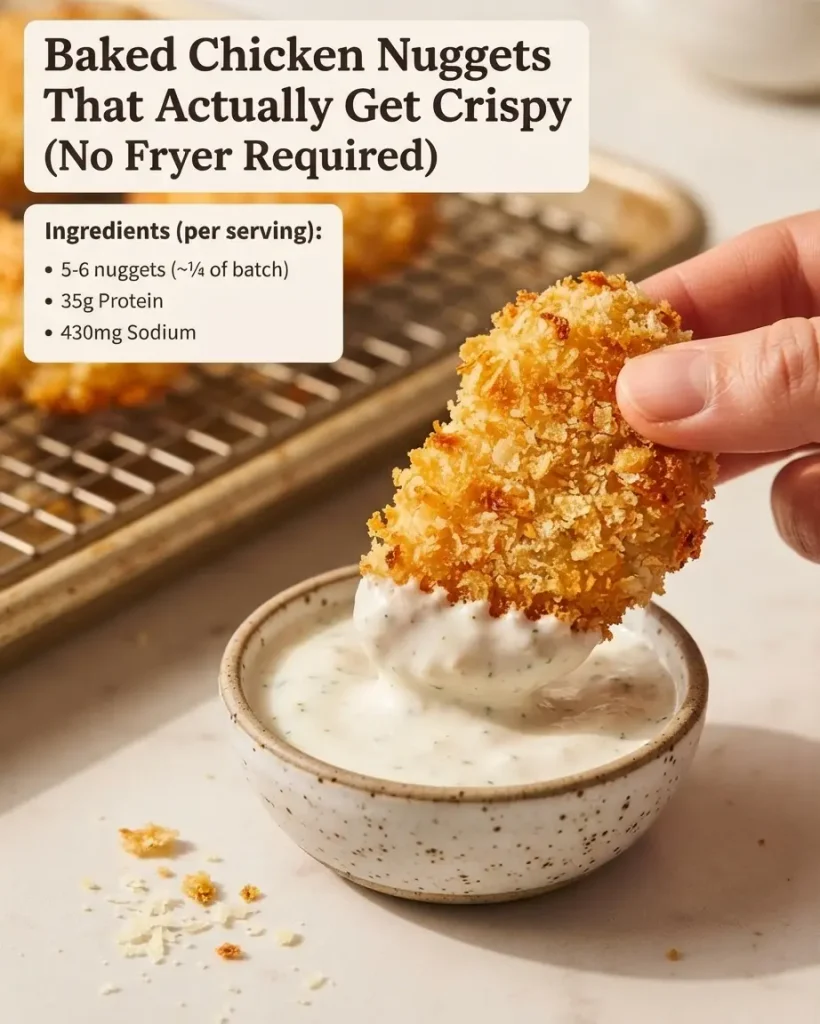
Prep time: 20 minutes Cook time: 20–22 minutes
Total time: about 40 minutes
Servings: 4 (roughly 20 nuggets)
Calories: ~320 per serving
Diet fit: heart-healthy, high-protein, low-sodium adaptable, anti-inflammatory-friendly
Crunchy outside, juicy inside, zero fryer involved.
What Actually Makes Baked Chicken Nuggets Crispy (The Kitchen Science, Briefly)
Before the steps, it’s worth understanding the mechanism, because once you know why crispiness happens, you stop needing a recipe to tell you exactly what to do — you can troubleshoot on your own.
Moisture Is the Enemy of Crunch
Frying works because oil transfers heat fast and evenly, flash-drying the coating’s surface almost instantly. A home oven, even a hot one, is slower and cooler by comparison — typically 375–425°F versus oil that’s already doing its job the moment food hits it. That gap means moisture management does more of the work in your kitchen than it does in a fryer.
Three things actually move the needle here:
- Pat the chicken completely dry before it touches flour. Surface water is the single biggest reason baked breading turns gummy instead of crisp.
- Don’t crowd the pan. Pieces touching each other trap steam between them, and steam is moisture’s more stubborn cousin.
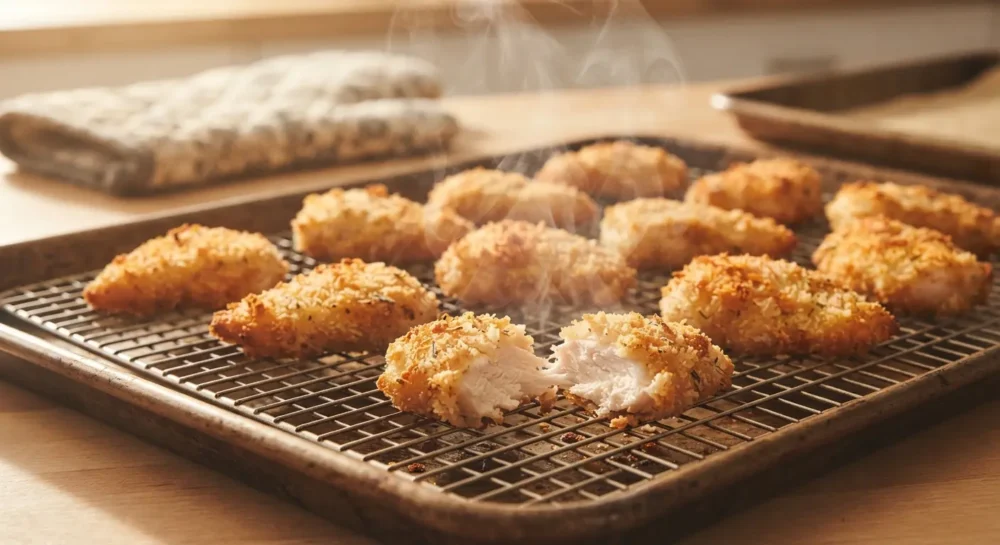
- Use a wire rack set inside your sheet pan, not a flat tray. Air needs to circulate underneath the nuggets, or the bottom half essentially steams in its own juices while the top browns.
The Three-Layer Breading System
A proper crust has structure: flour first (it gives the egg wash something to grip), then an egg or buttermilk wash (the glue layer), then breadcrumbs. Panko specifically — not standard fine breadcrumbs — is the better choice here, and not for aesthetic reasons. Panko’s flakes are larger and airier, which means more surface area, more little pockets for browning, and less breading mass absorbing oil in the first place.
Heat and Airflow
A preheated pan matters more than most home cooks assume. If your wire rack and sheet pan go into the oven cold, the bottom of each nugget spends its first few minutes just catching up to temperature instead of crisping. Preheat the pan along with the oven, and if your oven has a convection or fan setting, use it — the moving air does part of the job a fryer does automatically.
Ingredients for Baked Chicken Nuggets

| Ingredient | Amount | Notes |
| Boneless, skinless chicken breast (or thigh) | 1.5 lb, cut into 1–1.5″ cubes | Thigh meat is juicier and slightly higher in fat if you prefer that |
| Panko breadcrumbs | 1½ cups | Whole wheat panko works as a fiber-forward swap |
| All-purpose or whole wheat flour | ½ cup | For the initial dredge |
| Eggs | 2 large | Buttermilk is a good substitute if you want a tangier, more tenderizing wash |
| Olive oil | 2 tbsp | Or an oil mist spray if you want tighter control over total fat |
| Garlic powder | 1 tsp | |
| Onion powder | 1 tsp | |
| Smoked paprika | 1 tsp | Adds color and depth without added sodium |
| Salt | ½ tsp, adjustable | Start low — you can always add more at the table |
| Black pepper | ¼ tsp | |
| Grated parmesan (optional) | 2 tbsp | Adds savory depth and helps browning |
Substitutions: for a gluten-free version, use gluten-free panko and a rice flour or cornstarch dredge. For an egg-free wash, whisk milk with a teaspoon of mustard — the acidity helps the coating adhere similarly. Skip the parmesan for a dairy-free version; you won’t lose much crunch.
How to Make Crispy Baked Chicken Nuggets
- Preheat your oven to 425°F, and place a wire rack inside a rimmed sheet pan to preheat along with it.
- Pat the chicken cubes completely dry with paper towels. This step gets skipped more than any other, and it’s the one that matters most — see the moisture section above.
- Set up a three-station dredge: flour in one shallow bowl, whisked eggs in a second, and panko (mixed with the parmesan and spices) in a third.
- Coat each piece fully — flour, then egg, then panko — pressing the crumbs on gently so they actually adhere rather than just resting on the surface.
- Arrange the coated pieces on the preheated wire rack with visible space between each one. If they’re touching, you’re trading crispiness for steam.
- Lightly mist or brush with olive oil — about 2 tablespoons total across the whole batch. This is what pushes the panko from “toasted” to genuinely golden.
- Bake for 18–20 minutes, flipping the pieces at the halfway mark, until they’re golden brown and the internal temperature reaches 165°F — the USDA’s minimum safe temperature for cooked poultry, and non-negotiable regardless of how the outside looks.
- Allow them to cool for 2–3 minutes before serving. The crust actually sets a little more as it cools, which is easy to skip when you’re hungry and hard to regret when you don’t.
Troubleshooting, Diagnosed
If your baked chicken nuggets come out soggy or pale, here’s how to read the symptoms:
- Soggy coating → Diagnosis: trapped steam, usually from overcrowding, a flat pan instead of a rack, or chicken that wasn’t dried thoroughly. → Treatment: space the pieces out, use the wire rack, dry the chicken more aggressively than feels necessary.
- Pale, under-browned crust → Diagnosis: not enough surface fat, or an oven that wasn’t fully up to temperature. → Treatment: add a touch more oil mist, and confirm your oven’s actual temperature with an oven thermometer — many run cooler than their dial suggests.
- Dry interior → Diagnosis: overcooked past 165°F, or pieces cut too small and unevenly. → Treatment: use a meat thermometer instead of guessing by color, and cut chicken into uniform cubes so they finish at the same time.
Baked Chicken Nuggets Nutrition Facts (Per Serving)
Based on this recipe divided into 4 servings, roughly 5 nuggets each. Exact values will shift slightly depending on the brands you use.
| Nutrient | Amount |
| Calories | 320 |
| Protein | 35 g |
| Carbohydrates | 18 g |
| Fiber | 1 g |
| Sugar | 1 g |
| Sodium | 430 mg |
| Total Fat | 11 g |
That protein number is worth sitting with for a second: 35 grams from a single serving is a substantial share of most adults’ daily needs, coming almost entirely from lean chicken breast rather than a processed protein source. And at 430 mg of sodium, a serving uses roughly a fifth of the CDC’s general daily guidance — which leaves you real room for the rest of your day, something that’s harder to say about most breaded, fried alternatives.
Who These Baked Chicken Nuggets Are Good For
- Heart-healthy: built on unsaturated fat from olive oil, with no reused frying oil in the picture.
- High-protein: lean chicken breast is the dominant ingredient by weight.
- Low-sodium adaptable: the salt is measured and easy to reduce further if you’re watching your intake closely.
- Diabetic-friendly consideration: minimal added sugar, and pairing it with a fiber-forward side helps moderate the overall glycemic load of the meal — a general framing point, not a specific glycemic claim about the nuggets alone.
- Anti-inflammatory-friendly: baked rather than fried, with olive oil as the primary added fat, broadly consistent with the pattern of eating the American Heart Association and Mayo Clinic associate with lower inflammatory markers.
- Family-friendly: familiar enough for kids, adjustable enough for adults tracking something specific.
Baked Chicken Nugget Variations Worth Trying
- Buffalo-style: toss the baked nuggets in a light mix of hot sauce and a small amount of melted butter right after they come out of the oven.
- Herb-parmesan crust: add chopped fresh parsley or Italian seasoning to the panko mixture for a more herbaceous finish.
- Gluten-free: gluten-free panko plus an almond flour dredge instead of wheat flour.
- Air fryer version: if you own one, 400°F for about 10–12 minutes, flipping halfway, gets you a similar result faster — worth knowing even though this recipe is written for a standard oven.
How to Store and Reheat Baked Chicken Nuggets
Cooked nuggets keep well in an airtight container in the refrigerator for up to 3–4 days. For longer storage, you actually get a better result freezing them before baking: arrange the breaded, uncooked pieces on a tray until solid, then transfer to a freezer bag. Baking from frozen preserves the coating’s texture better than freezing already-cooked nuggets, which tend to lose some crispness in the freeze-thaw cycle.
When reheating, skip the microwave if you can — it reintroduces moisture and steams the coating rather than re-crisping it. A hot oven or air fryer for 8–10 minutes will bring the crunch back far more reliably.
What to Serve With Them
These baked chicken nuggets pair well with:
- Roasted broccoli or Brussels sprouts, for a vegetable that can handle the same oven temperature at the same time.
- A whole grain side — farro, brown rice, or quinoa — to round out the plate with additional fiber.
- A yogurt-based dip, like a garlic-herb Greek yogurt sauce, instead of a sugar-heavy bottled sauce. It gets you the same dipping ritual with a very different nutrition profile.
FAQ
Are baked chicken nuggets actually healthier than fried ones?
Generally, yes — mainly because of fat quality and sodium control rather than calories alone. Baking avoids the oxidized fats associated with reused frying oil, and making the coating yourself means you control the salt. But “healthier” here is about the overall pattern, not a claim that any single dinner changes your health outcomes.
Can I make crispy baked chicken nuggets without breadcrumbs?
Yes. Crushed cornflakes or a mix of almond flour and grated parmesan both create a crunchy crust, though the texture will be slightly different from panko — cornflakes tend to shatter a bit more, almond flour browns faster and can scorch if your oven runs hot.
Myth:
baked food is always lower-calorie than fried food. Not automatically true, and it’s worth knowing why. The calorie difference between baking and frying comes almost entirely from how much oil ends up in the food, not from the cooking method itself. Fat carries about 9 calories per gram, so a “baked” recipe made with a heavy hand on the oil can end up close to a lightly fried one. The method matters less than the amount of added fat — which is exactly why this recipe measures the oil instead of leaving it to “as needed.”
How do I reheat baked chicken nuggets without losing the crunch?
Use an oven or air fryer at around 375–400°F for 8–10 minutes. The microwave is faster, but it steams the coating rather than re-crisping it, and you’ll notice the difference immediately.
Can I freeze baked chicken nuggets?
Yes, and freezing them uncooked (breaded but unbaked) generally preserves the texture better than freezing after baking. Bake directly from frozen, adding a few extra minutes to the cook time.
A quick note: this article is for general educational purposes and isn’t personalized medical or nutrition advice. If you’re managing a specific condition — kidney disease, diabetes, a food allergy, or anything else where sodium, protein, or fat intake needs close monitoring — Consult a doctor or dietitian before making major dietary changes.
Conclusion
I still think about that freezer aisle sometimes — not with guilt, but with relief that baked chicken nuggets turned out to be so answerable a problem. Crispiness was never actually locked behind a deep fryer. The key was controlling moisture, something you can easily manage with a wire rack, a dry paper towel, and a little patience while the nuggets cook.
If you make these, I’d genuinely like to know how the texture turned out for you — drop a comment below with what worked, what you changed, or what you’re serving them with. And if you want more recipes built this way, translating the science behind a craving instead of just handing you a recipe, subscribe to the DocCuisine newsletter — I send one of these every week, along with the research that shaped it. Start Cooking, and let me know what you think.
What Readers Think :
There are no reviews yet. Be the first one to write one.