Beef Stock: How to Make a Rich Homemade Stock (And What Your Bones Are Actually Giving Up)
You remember the night differently than you’d expect. Not the chaos of the shift — the codes, the charts, the third cup of vending-machine coffee — but the walk home afterward, keys shaking slightly in your hand, stomach hollow in that specific way that has nothing to do with hunger and everything to do with depletion.
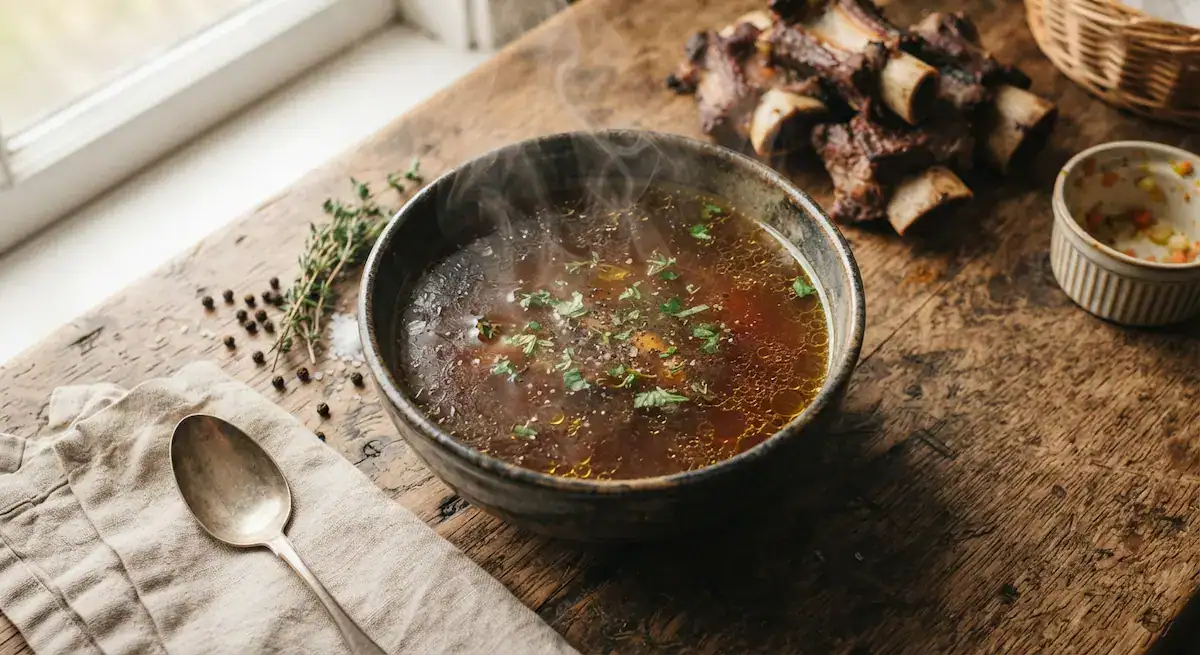
In the fridge, your roommate had left a mason jar with a handwritten note: “Heat, don’t microwave. Love you.” Inside sat a rich amber beef stock, topped with a layer of cooled fat that had hardened into a protective seal.. You ate it standing at the counter, too tired to sit, and felt — within minutes, which felt suspicious at the time — steadier.
It would take another year of medical school before you understood why that worked.Not as a tradition handed down without explanation or a simple case of “grandma was right,” but as something you could understand well enough to explain to a patient.
Beef stock isn’t magic. It’s chemistry, patience, and a handful of minerals doing exactly what minerals do. And once you understand the mechanism, making it yourself stops being a weekend chore and starts feeling like something closer to preparation — the kind you do before the bad week, not during it.
This is a full walkthrough for building a rich, restorative beef stock at home, along with an honest look — no exaggerated claims, no miracle-broth marketing — at what the science actually says it’s doing for your body.
Table of Contents
Doctor’s Note: Why This Matters, Medically Speaking
Before you touch a single bone, here’s the short version of the medical angle, because it shapes almost every decision in this recipe.
Beef stock delivers three things your body genuinely uses: protein in an easily digestible, low-fiber liquid form; electrolytes and trace minerals (potassium, phosphorus, small amounts of magnesium) released slowly during cooking; and, when made without excess salt, a way to get warmth, hydration, and flavor without the sodium load of a store-bought carton.
That last point matters more than people think — a cup of commercial ready-to-serve beef broth can carry upward of 800mg of sodium, largely because sodium is doing the flavor work that a long, proper extraction would otherwise do on its own.
There’s also the collagen question, which deserves a straight answer instead of a marketing one. Concentrated hydrolyzed collagen peptide supplements — not homemade stock, but purified powders taken at controlled doses — have shown measurable, if modest, improvements in joint pain and stiffness scores in people with osteoarthritis across several randomized trials.
A double-blind, placebo-controlled trial using collagen peptides from bovine bone sources found significant reductions in pain and stiffness scores compared to placebo over a 13-week period. That’s real, published evidence — but it’s evidence for a specific, concentrated supplement, not proof that a bowl of beef stock will do the same thing for your knees.
Homemade beef stock almost certainly contains far less collagen per serving than those study doses. The honest takeaway: beef stock is a good source of dietary protein and gelatin, and the collagen research is promising for the ingredient — but a cup of stock is not a clinical intervention.
There’s a useful parallel here, too. The most-cited study on soup and illness recovery — a 2000 CHEST journal study led by researchers at the University of Nebraska Medical Center found that chicken soup significantly inhibited neutrophil migration in a laboratory test, suggesting a mild anti-inflammatory effect that could help explain why warm soup eases cold symptoms — was conducted on chicken soup, not beef stock.
It’s not a beef stock study, and it would be dishonest to present it as one. But the underlying logic — that a warm, mineral-rich, protein-containing liquid can support your body during illness or depletion, independent of any single “magic” compound — extends reasonably to a well-made beef stock too.
UConn study
Parkview explanation
What Stock Actually Is (And Why It’s Not the Same as Broth)

People use “stock” and “broth” interchangeably, and for casual cooking, that’s fine. Medically and culinarily, though, there’s a real distinction worth knowing.
- Broth is typically made from meat, simmered relatively briefly, and tends to be thinner and lighter in body.
- Beef stock is built primarily from bones — often roasted first — and simmered far longer, which pulls collagen out of connective tissue and converts it into gelatin.
You can test this yourself: a properly made beef stock, once refrigerated, should wobble. If it sets into something closer to a loose jelly than a liquid, you’ve successfully extracted collagen.
If it stays completely liquid at fridge temperature, you either didn’t use enough bone, didn’t cook it long enough, or didn’t include joints and connective tissue where collagen concentrates.
The Extraction Principle: What the Bones Are Telling You
Here’s the framing that changed how I think about this recipe.
Taking a good patient history means asking the right questions patiently, in the right order, without rushing past something important. Building a beef stock works the same way. You’re not “cooking” so much as interviewing the bones — slowly drawing out what they hold, one compound at a time, at a pace that respects the process.
Roasting First: The Maillard Step
Roasting the bones at high heat (around 400°F/200°C) for 40–45 minutes before they ever touch water triggers the Maillard reaction — the browning process responsible for the deep, savory complexity that separates a rich beef stock from a pale, flat one.
Skipping this step is the single most common reason home stocks taste thin.
Acid: The Extraction Assistant
A splash of vinegar or a cup of wine in the pot does real chemical work: mild acidity helps draw calcium and other minerals out of bone and connective tissue and into the liquid.
You won’t taste the vinegar in the finished beef stock — it cooks off and balances out over hours — but its presence is part of why long-simmered stock is more mineral-dense than a quick 45-minute batch.
Time and Temperature: Low and Slow, On Purpose
A rolling boil is the enemy of a clear, rich beef stock. High heat agitates fat and protein into the liquid, producing cloudiness and a slightly muddled flavor.
A gentle simmer — small bubbles breaking the surface occasionally, not a boil — over 8 to 12 hours gives collagen time to convert fully into gelatin without breaking the stock’s clarity.
What’s Actually in the Pot: Nutrition Facts
Values below are for homemade beef stock, unsalted (or lightly salted at the end, per this recipe), per 1-cup (240ml) serving.
Store-bought and heavily salted versions will differ, sometimes significantly, in sodium.
| Nutrient | Amount (approx., per 240ml) |
| Calories | 30–40 kcal |
| Protein | 5–6 g |
| Carbohydrates | 0–2 g |
| Fiber | 0 g |
| Sugar | 0 g |
| Sodium | 50–350 mg (unsalted to lightly salted) |
This is a low-calorie, low-carbohydrate, essentially fat-free (once skimmed) source of protein — which is part of why beef stock has long been a go-to for people recovering from illness, surgery, or simply a depleting stretch of life, medically speaking or otherwise.
The Ingredients

| Ingredient | Quantity | Why It’s There |
| Beef bones (marrow + knuckle/joint) | ~2 kg (4.4 lb) | Collagen and gelatin source |
| Yellow onion | 2, halved | Aromatic base, natural sweetness |
| Carrots | 2, roughly chopped | Sweetness, trace minerals |
| Celery | 2 stalks | Classic aromatic backbone |
| Garlic | 4 cloves, smashed | Depth of flavor |
| Apple cider vinegar | 2 tbsp | Assists mineral extraction |
| Bay leaf, peppercorns, thyme | To taste | Aromatic finishing notes |
| Cold water | To cover (~4–5 L) | Extraction medium |
| Salt | Added at the end only, to taste | Full sodium control |
Step-by-Step: Building the Stock
1. Roast the Bones
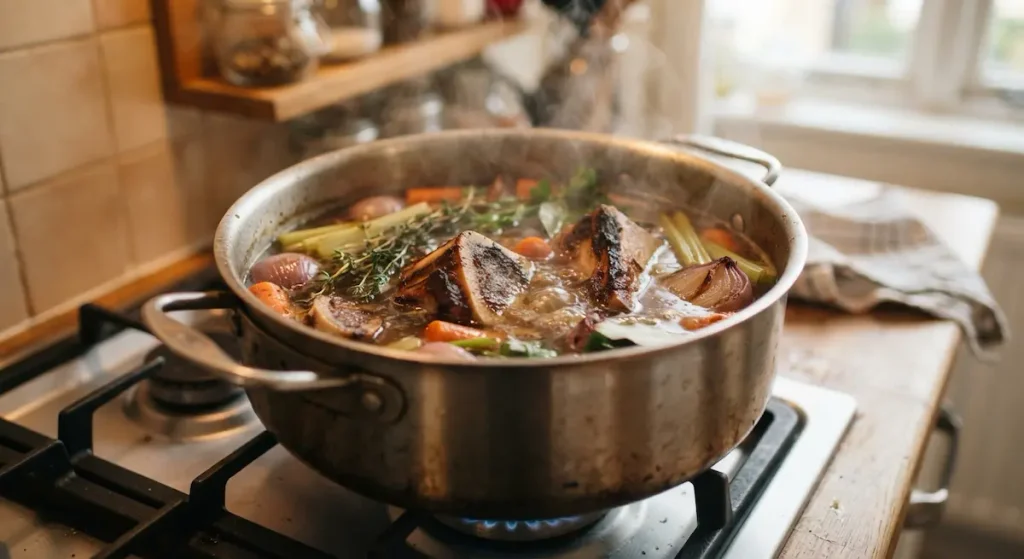
Roast at 400°F (200°C) for 40–45 minutes, turning once, until deeply browned.
2. Deglaze the Roasting Pan
Deglaze the roasting pan with a splash of water or wine, scraping up the browned bits — this is flavor you don’t want to leave behind.
3. Transfer Everything to a Stockpot
Transfer everything to a stockpot, cover with cold water, and add the vinegar.
4. Bring to a Bare Simmer
Heat over medium-low until the stock reaches a gentle simmer — avoid letting it come to a boil.
5. Skim the Surface
Skim the surface during the first hour as grey foam rises. This is coagulated protein, and removing it keeps your beef stock clear.
6. Add the Vegetables and Aromatics
Add the vegetables and aromatics partway through, so they don’t overcook into mush.
7. Simmer Gently
Simmer gently for 8–12 hours, topping up water as needed to keep the bones submerged.
8. Strain, Cool, and Refrigerate
Strain, cool, and refrigerate. Skim the solidified fat layer off the top once chilled — this is also your easiest way to control the final fat content.
Who This Recipe Fits: Dietary Compatibility
- High-protein — meaningful protein per serving with essentially no fat once skimmed
- Low-carbohydrate / diabetic-friendly — negligible carbs or sugar
- Heart-healthy — when salted only at the end, sodium stays well below commercial versions
- Gluten-free and dairy-free, naturally
- Not vegetarian or vegan — this one’s non-negotiable, for obvious reasons
Common Mistakes (And How to Fix Them)
Cloudy Stock
Usually from boiling instead of simmering. Lower the heat and skim more diligently next time.
Flat, Thin Flavor
Not enough bone roasting, or the batch was rushed. Beef stock rewards patience more than almost any other kitchen project.
Too Greasy
Chill it fully before use; the fat cap lifts off cleanly once solid, giving you full control over the final fat content.
Storage
Beef stock keeps 4–5 days refrigerated, or up to 6 months frozen.
Freezing in ice-cube trays or flat-packed freezer bags makes portioning painless — you can pull exactly what a recipe (or a rough week) requires.
FAQ
How many days does homemade beef stock keep in the fridge?
Properly cooled and stored in an airtight container, homemade beef stock keeps safely for 4–5 days in the refrigerator, or several months in the freezer.
Is beef stock the same as bone broth?
They’re closely related and, in many cases, food marketing uses the terms as though they mean the same thing. Traditionally, “bone broth” implies an even longer simmer time specifically focused on bones, while beef stock includes bones plus aromatics simmered for a shorter (though still long) window.
Nutritionally, the two can be quite similar when they’re prepared well.
Can homemade beef stock really heal your gut or joints?
This is the myth worth addressing directly: no single food “heals” a joint or an intestinal lining on its own, and beef stock is no exception.
What the evidence actually supports is more modest — collagen and gelatin are digestible proteins your body can use, and concentrated collagen supplements have shown measurable (not dramatic) benefits for joint symptoms in clinical trials.
Treat beef stock as a nourishing, protein-rich food that fits well into a healthy pattern of eating — not a cure for anything specific.
Can You Prepare Beef Stock in a Slow Cooker or Pressure Cooker?
Yes. A slow cooker on low for 12–24 hours works well; a pressure cooker can produce a comparably rich beef stock in 2–3 hours under pressure, which is a genuinely useful shortcut on a busy week.
A Quick Medical Disclaimer
The information in this article is for general educational purposes and is not intended to replace individualized guidance from a qualified medical or nutrition professional.
If you have a specific health condition — kidney disease, hypertension, a sodium-restricted diet, or any other concern — please consult your physician or a registered dietitian before making significant dietary changes.
Conclusion
There’s something fitting about the fact that beef stock can’t be rushed.
You can’t shortcut an extraction — not a good clinical history, and not a good stock. Both reward the same thing: patience, attention, and a willingness to let something slow do its work properly.
That jar in my fridge, all those months ago, wasn’t a miracle cure. It was protein, minerals, and warmth, delivered at exactly the moment I needed all three.
That’s not nothing.
Sometimes it’s exactly enough.
Made a batch this weekend?
I’d genuinely love to hear how it turned out — drop a comment below with your results (or your own “the night this saved me” story), share this with anyone who could use a steadier week, and if you want more evidence-based recipes with an actual medical lens behind them, subscribe to the DocCuisine newsletter.
Food first, medicine second — one nourishing pot at a time.
What Readers Think :
There are no reviews yet. Be the first one to write one.