
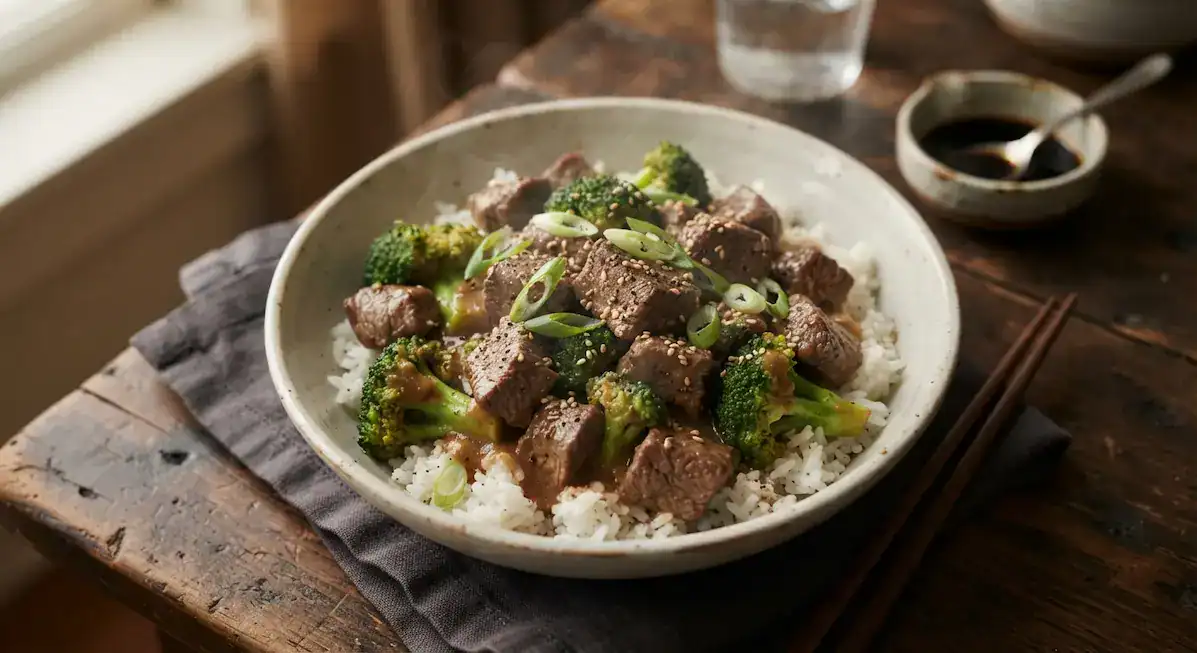
Beef and Broccoli Crockpot: The Patience Method for a Tender Dinner
There’s a specific kind of exhaustion that comes with a 24-hour call shift — the kind where you stop noticing hunger somewhere around hour fourteen, and then it hits you all at once the second you walk through your own front door.
On those nights, I’ve learned not to trust future-me to cook anything. So I’ve started trusting past-me instead: the version of me who, eight hours earlier, loaded a chuck roast, some broccoli, and a homemade sauce into a slow cooker before leaving for the hospital.
That’s the appeal of a beef and broccoli crockpot recipe, honestly. It’s not just convenience. It’s the specific relief of walking into a kitchen that smells like it’s already taken care of you, on a day when you had nothing left to give it.
What I didn’t expect, the first time I really thought about it, was how much the process of slow cooking mirrors something I’d spent years reading about in a different context. A tough cut of beef doesn’t get tender because you throw more heat at it. It gets tender because you give it time at a sustainable temperature.
Rush it, and you just end up with something that’s technically cooked but still stubbornly tough. It turns out that’s not just a loose metaphor for how bodies heal, either. The chemistry behind it is genuinely, almost literally, similar.
Table of Contents
The Medical Perspective: Why This Dish Is Worth Making
Here’s the version of this I’d actually tell you if we were talking between patients instead of on a page.
Beef is a source of heme iron, and heme iron matters more than people usually give it credit for. According to the NIH’s Office of Dietary Supplements, the body absorbs heme iron — the kind found in meat — considerably more efficiently than the non-heme iron found in plant sources, and iron plays a central role in transporting oxygen through your blood and supporting normal energy metabolism.
I’m not going to tell you a beef and broccoli crockpot dinner will single-handedly fix fatigue from a punishing schedule. But if you’re running on broken sleep and long shifts, knowing that one of your regular meals is genuinely supporting that system is worth something.
Protein does its own quiet work here too. Beef delivers a complete amino acid profile, and general USDA and NIH guidance is consistent on this point: adequate protein intake supports tissue maintenance and repair.
That’s the same idea threading through the collagen conversion happening in your slow cooker, just at a completely different scale — time and sustained, moderate conditions doing work that force and speed can’t shortcut.
Then there’s the broccoli, which is doing more than adding color. Cruciferous vegetables like broccoli are consistently associated, in nutrition research referenced by sources like the NIH and Mayo Clinic, with dietary patterns linked to antioxidant activity and lower markers of inflammation.
I’m not going to hand you an invented statistic about a specific compound — the honest version is that eating more vegetables like this, regularly, is one of the more reliably useful things you can do for your long-term health, and this recipe makes that easy instead of effortful.
And then there’s sodium, which is where most versions of this dish quietly go wrong. Most bottled stir-fry or crockpot sauces are loaded with it — often well past what you’d guess from taste alone.
The CDC’s general guidance keeps most adults under roughly 2,300 milligrams of sodium a day, and a single serving of a bottled-sauce version can eat into a meaningful chunk of that number before you’ve even added rice.
Building the sauce yourself for this beef and broccoli crockpot recipe means you’re not guessing. You’re choosing the number.
None of this is about any single miracle ingredient. It’s that the whole plate, made this way, does quiet, unglamorous nutritional work — which is a more honest promise than most recipes make, and the one I actually want to keep with you.
Quick Recipe Card
Here’s this beef and broccoli crockpot recipe at a glance, before we get into the why and how.
Prep time: 15 minutes
Cook time: 7–8 hours on low, or 3.5–4 hours on high
Total time: about 7.5–8.5 hours (mostly hands-off)
Servings: 5–6
Calories: ~340 per serving
Diet fit: high-protein, iron-supportive, low-sodium adaptable, heart-healthy consideration, diabetic-friendly consideration
Set it, forget it, come home to something that tastes like it took all day — because it did, just not your day.
Why Slow Cooking Works: The Science Behind It
Before the recipe itself, it’s worth understanding why a beef and broccoli crockpot method produces a better result than trying to rush the same ingredients on a stovetop.
Once you understand the mechanism, you stop needing exact instructions and start being able to troubleshoot on your own.
Collagen Doesn’t Rush
Tough cuts like chuck roast are dense with collagen, a connective protein that’s rigid and chewy at low temperatures — which is exactly why a quick sear leaves it tough no matter how long you cook it hot and fast.
Sustained heat in roughly the 180–200°F range, held for several hours, slowly converts that collagen into gelatin. That conversion is what makes slow-cooked beef fall-apart tender instead of merely “cooked through.”
Crank the heat instead, and you get the opposite problem: the muscle fibers cook fast, the meat technically reaches a safe temperature, but the collagen never gets the time it needs to break down.
You end up with beef that’s done and still tough — which is the single most common complaint about rushed versions of this dish.
It’s worth sitting with the parallel for a second, because it’s not just a clever opener. The same principle governs why rushing recovery — physical or otherwise — tends to backfire.
Time at a sustainable level of effort does the actual repair work. Intensity alone doesn’t.
Why Broccoli Goes in Late
Here’s a detail that separates a good beef and broccoli crockpot recipe from a mediocre one: broccoli added at the start of an eight-hour cook turns to olive-colored mush by the time the beef is ready.
Adding it in only the final 20 to 30 minutes keeps it bright, gives it a little textural bite, and better preserves its water-soluble vitamins, which degrade further the longer they sit in prolonged moist heat.
There are three practical reasons this matters:
- It preserves the textural contrast against the tender beef, which is most of what makes the dish satisfying to eat.
- It reduces nutrient loss compared to hours of simmering.
- It keeps the color appetizing instead of drab.
Building the Sauce Without a Bottle
A good sauce needs four functional things: a salty base (reduced-sodium soy sauce or tamari), a thickener (a cornstarch slurry, added near the end), aromatics (garlic and ginger), and a touch of sweetness to balance the salt (honey or brown sugar, in modest amounts).
Cornstarch specifically goes in late rather than at the start of cooking, because added too early, it can break down over a long cook time and quietly lose its thickening power — leaving you with a thin, watery sauce despite having measured it correctly.
Ingredients for Beef and Broccoli Crockpot

| Ingredient | Amount | Notes |
| Beef chuck roast, sliced into strips or bite-sized pieces | 1.5–2 lb | Chuck’s collagen content is exactly why it works here; leaner cuts won’t get as tender |
| Broccoli florets | 3–4 cups | Added in the last 20–30 minutes, not at the start |
| Reduced-sodium soy sauce or tamari | 1/2 cup | The main sodium-control lever in this recipe |
| Beef broth (low-sodium) | 1/2 cup | |
| Garlic, minced | 3–4 cloves | |
| Fresh ginger, grated | 1 tbsp | |
| Honey or brown sugar | 2–3 tbsp | Adjustable to taste; balances the soy sauce’s saltiness |
| Rice vinegar | 1 tbsp | Adds brightness without added sodium |
| Cornstarch | 2 tbsp cornstarch, blended with 2 tbsp cold water | Added near the end to thicken |
| Sesame oil | 1 tsp | A finishing touch, not a cooking fat |
| Green onions, sesame seeds | For garnish |
If you need it gluten-free, tamari or coconut aminos swap in cleanly for the soy sauce. Arrowroot starch works in place of cornstarch at the same ratio.
And if you’d rather prioritize lower fat over maximum tenderness, a leaner cut will work — just know honestly that it won’t shred the same way chuck does.
How to Make a Beef and Broccoli Crockpot Dinner
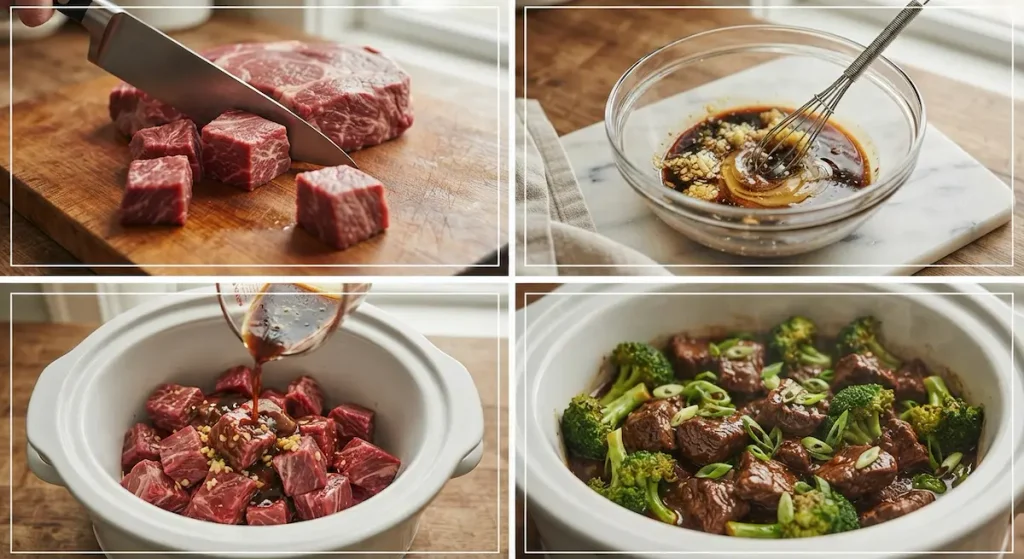
- Trim excess fat from the chuck roast and cut it into 1.5–2 inch chunks or strips.
- In a separate bowl, whisk together the soy sauce, beef broth, garlic, ginger, honey, and rice vinegar — this is your base sauce.
- Place the beef in the crockpot and pour the sauce over it, making sure the pieces are mostly submerged.
- Cook on the low setting for 7–8 hours, or on high for 3.5–4 hours, until the beef is tender enough to pull apart easily with a fork. This is the collagen-to-gelatin conversion described above, and it’s genuinely not a step you can shortcut.
- In the final 20–30 minutes of cooking, stir in the broccoli florets and cover again — late enough to preserve texture, early enough for it to cook through.
- Whisk the cornstarch slurry and stir it into the crockpot during that same final window, letting the sauce thicken as it finishes.
- Taste and adjust: more soy sauce for depth, more honey for balance, more rice vinegar if it needs brightness.
- Finish with a drizzle of sesame oil, green onions, and sesame seeds just before serving.
Troubleshooting, Diagnosed
If your beef and broccoli crockpot dinner doesn’t turn out quite right, here’s how to read what went wrong:
- Beef is tough after cooking → Most likely cause: not enough time for the collagen to convert, or a leaner cut was swapped in without accounting for the difference. → Fix: extend the cook time, and confirm you used chuck roast rather than something leaner.
- Broccoli is mushy and drab → Most likely cause: added too early. → Fix: add it only in the final 20–30 minutes from now on.
- Sauce is thin and watery → Most likely cause: the cornstarch slurry was skipped, added too early, or didn’t get enough time to thicken after going in. → Fix: whisk a fresh slurry and stir it in during that last 20–30-minute window, giving it time to actually do its job.
Nutrition Facts (Per Serving)
Nutrition values are based on the recipe divided into 6 servings. Exact values will shift depending on the specific cut and brands you use.
| Nutrient | Amount |
| Calories | 340 |
| Protein | 32 g |
| Carbohydrates | 14 g |
| Fiber | 2 g |
| Sugar | 7 g |
| Sodium | 520 mg |
| Total Fat | 17 g |
That protein number is doing real work in this dish — 32 grams from a single serving, coming from both the beef and, to a smaller degree, the broccoli.
And at 520 mg of sodium, a serving of this beef and broccoli crockpot recipe uses under a quarter of the CDC’s general daily guidance, which is a meaningfully different picture than the sodium load in most bottled-sauce versions of the same meal.
Who This Recipe Fits
Here’s who a beef and broccoli crockpot dinner like this one fits particularly well:
- High-protein: both the chuck roast and the broccoli contribute meaningfully to the total.
- Iron-supportive: heme iron from beef, worth knowing about if you’re managing a heavy schedule or broken sleep — framed generally, not as a treatment for diagnosed anemia.
- Low-sodium adaptable: built around a measured, reduced-sodium soy sauce rather than a bottled sauce, so the number is in your control from the start.
- Heart-healthy consideration: trimming visible fat from the chuck roast before cooking meaningfully reduces the saturated fat load — a genuinely actionable step, not just a label.
- Diabetic-friendly consideration: added sugar is measured and adjustable, and pairing the dish with a modest rice portion, or skipping rice entirely, keeps the total carbohydrate load in your hands.
- Anti-inflammatory-adjacent: the broccoli fits a broader, vegetable-forward eating pattern associated with lower inflammatory markers, without claiming this single dish changes that on its own.
Variations Worth Trying
- Swap the chuck roast for thinly sliced flank steak for a faster-cooking version — it won’t shred the same way, but it’s a reasonable tradeoff on a shorter timeline.
- Add sliced bell peppers or snap peas alongside the broccoli in that final cooking window for more color and fiber.
- For a spicier version, stir a teaspoon of red pepper flakes or a spoonful of chili garlic sauce into the base sauce.
- For a lower-carb version, serve over cauliflower rice instead of white or brown rice.
Storage and Reheating
Refrigerate leftovers in an airtight container for up to 3–4 days.
This beef and broccoli crockpot recipe also freezes well for up to about 3 months, though it’s worth knowing honestly that the broccoli’s texture softens further after freezing and reheating — still good, just less crisp than fresh.
Reheat gently, on the stovetop or in the microwave in short intervals, stirring between rounds so you don’t cook the broccoli any further than it already has been.
What to Serve With It
- Steamed jasmine or brown rice, to catch the sauce.
- Cauliflower rice, for a lower-carb version of the same plate.
- A simple cucumber salad, for a cool, crisp contrast against the tender beef.
FAQ
How long does beef and broccoli crockpot cooking actually take?
On low, plan for 7–8 hours; on high, 3.5–4 hours. Low is generally the better default here, since the longer, gentler timeline gives the collagen more room to fully convert, which is what gets you genuinely tender beef instead of just cooked beef.
Can I put raw broccoli in a beef and broccoli crockpot recipe from the start?
Technically, yes — but you’ll lose both texture and some nutritional integrity along the way.
Adding it in the final 20–30 minutes instead gets you broccoli that’s cooked through without turning to mush, and it holds onto more of its water-soluble vitamins in the process.
Myth: slow cooker meals are always healthier than stovetop meals.
Not automatically true, and it’s worth understanding why.
The cooking method itself doesn’t determine how healthy a meal is — a crockpot dish made with a bottled sauce can carry considerably more sodium and added sugar than a quick stovetop version made from scratch.
What actually matters is what’s going into the pot, not which appliance it’s cooking in. That’s exactly why this recipe measures its own sauce rather than reaching for a bottle.
What cut of beef is best for a beef and broccoli crockpot recipe?
Chuck roast, specifically because of its collagen content. That connective tissue is what gives you fall-apart tenderness after a long, low cook — a leaner cut will finish “done” faster, but it won’t shred the same way.
Can I make this ahead of time?
Yes. You can prep the beef and sauce the night before and store them together, covered, in the refrigerator, then start the crockpot in the morning.
This also works well for meal-prepping a few days of lunches at once.
A quick note before you cook: this article is for general educational purposes and reflects a food-first perspective, not personalized medical advice. If you’re managing a specific health condition — anemia, heart disease, diabetes, kidney disease, or anything else that requires close dietary attention — talk to your doctor or a registered dietitian before making significant changes to your diet.
Conclusion
I still think about that first night I really noticed the parallel — coming home after a shift that had asked more of me than I had to give, to a kitchen that had spent the same hours doing something patient and unglamorous on my behalf.
The beef didn’t get tender because anyone rushed it. It got tender because it had time, at a temperature it could actually work with.
That’s the whole case for a beef and broccoli crockpot dinner, really. It’s not a shortcut. It’s a different kind of effort — one that trades active attention for time, which is often the harder thing to give yourself on a long day.
If you make this one, I’d love to hear how it turned out — drop a comment with any swaps you tried, or tag DocCuisine if you post it.
And if you want more recipes built this way, with the health reasoning laid out honestly instead of buried under hype, subscribe to the newsletter — the next one’s coming soon.


