

Tuna Salad With Greek Yogurt: Easy No-Mayo Lunch
I started making this tuna salad with Greek yogurt during a gastroenterology rotation, back when my lunch break was fifteen minutes long and my stomach had opinions about everything I put into it.
For years, my go-to had been the same mayo-heavy tuna salad from whatever cafeteria I happened to be standing in — reliable, familiar, and, as it turned out, exactly the wrong choice for an afternoon on my feet.
I remember the day it clicked. I’d eaten my usual tuna salad before rounds, and about an hour in, I felt that heavy, sluggish fullness that makes you want to sit down somewhere quiet.
One of the GI attendings I was shadowing mentioned, almost in passing, that high-fat meals slow gastric emptying — the rate at which food actually leaves your stomach.
It wasn’t news to me, exactly. I’d learned it in a lecture hall months earlier. But hearing it connected to my own lunch made it real in a way the textbook never had.
So I went home and rebuilt the recipe. Same tuna. Same crunch. No mayo. In its place: plain Greek yogurt, which brought a similar creaminess without the heavy fat load — and, as a bonus, a dose of live cultures that mayo never offered in the first place. It worked. I kept making it. And now, whenever someone asks me for an easy lunch that won’t leave them foggy an hour later, this is the one I hand over.
This isn’t a mayo-shaming exercise. It’s a gut-timing one — and once you understand the mechanism, the swap makes a lot more sense than “healthy because it’s yogurt.”
Table of Contents
Doctor’s Note: Why This Swap Actually Matters
Here’s the plain-language version of what’s happening on your plate.
Mayonnaise is mostly oil — somewhere in the neighborhood of three-quarters fat by volume. Fat isn’t something you need to avoid; your body relies on it.
But a meal that’s very high in fat takes longer to move out of your stomach and into your small intestine, a process called gastric emptying. For most people, that’s a minor inconvenience — maybe a bit of post-lunch heaviness.
For people with reflux, functional dyspepsia, or a generally sensitive gut, a slower-emptying stomach can mean more time for acid to sit around, more bloating, and more of that “I shouldn’t have eaten that” feeling.
The Mayo Clinic and NIH both note that high-fat meals are a common, modifiable trigger for reflux symptoms — not the only one, but a real one.
Swap the mayo for plain Greek yogurt, and you immediately lower that fat load while keeping the creamy texture that makes tuna salad satisfying in the first place. That’s the first piece of why a tuna salad with Greek yogurt sits more comfortably with a lot of people than the traditional version.
The second piece is the live cultures. Plain Greek yogurt — assuming it’s labeled with the “Live & Active Cultures” seal and hasn’t been heat-treated after culturing — contains bacterial strains like Lactobacillus bulgaricus and Streptococcus thermophilus. Research reviewed by the NIH’s National Institute of Diabetes and Digestive and Kidney Diseases suggests these cultures may support a more diverse gut microbiome, though the effect size and clinical significance vary by individual and aren’t a guaranteed fix for any specific condition.
I want to be careful here: this isn’t a miracle claim. It’s a “probably helps, definitely doesn’t hurt” kind of benefit, and it’s one more reason a tuna salad with Greek yogurt earns its place in a digestive-health-focused kitchen.
Third, there’s the protein angle. Tuna and Greek yogurt together give you a combination of lean fish protein and dairy protein (whey and casein) that’s generally well tolerated and digests without the extra fat that can slow things down. According to USDA FoodData Central, a tablespoon of plain Greek yogurt carries a fraction of the fat found in the same amount of mayonnaise, while contributing meaningful protein of its own. That’s a quiet but real upgrade, tablespoon for tablespoon.
What “Digestive Health” Actually Means Here
It’s easy to slap “gut-friendly” on a recipe label and move on. I’d rather be specific.
A sensitive digestive system tends to react to three things in particular:
- A heavy fat load, which slows gastric emptying and can worsen reflux or bloating
- Low fiber paired with refined carbohydrates — think white bread and iceberg lettuce doing all the heavy lifting
- A lack of live cultures or microbiome-supportive ingredients in the overall diet
This version of tuna salad with Greek yogurt intervenes on all three fronts at once. The yogurt lightens the fat load. The celery adds a bit of real fiber and water content. And the live cultures — assuming your yogurt has them — nudge the microbiome piece in a favorable direction. On its own, each of these tweaks looks almost too small to matter . Together, they add up to a meal that asks less of your gut than the version it’s replacing.
The Ingredients — and Why Each One Earns Its Place

| Ingredient | Amount | Role |
| Canned tuna (packed in water) | 2 cans (5 oz each), drained | Lean protein base |
| Plain Greek yogurt (2% or full-fat) | ½ cup | Creaminess, protein, live cultures |
| Celery, finely diced | ½ cup | Fiber, crunch, water content |
| Red onion, finely diced | 2 tablespoons | Flavor (or swap for scallion greens) |
| Fresh lemon juice | 1 tablespoon | Brightness, cuts richness |
| Dijon mustard | 1 teaspoon | Depth of flavor, no added fat |
| Fresh dill (optional) | 1 tablespoon | Aromatic, traditionally used to ease digestion |
| Salt and black pepper | To taste | — |
A Note on the Swaps
Water-packed tuna, rather than oil-packed, keeps the overall fat content of your tuna salad with Greek yogurt lower without sacrificing protein — USDA data shows the protein content is nearly identical between the two, so you’re not giving anything up nutritionally by choosing water-packed.
As for the yogurt itself, full-fat and 2% are both reasonable choices. Full-fat will taste richer and keep you fuller longer; 2% trims a bit more fat if that’s your priority. Neither one undoes the benefits of the swap — you’re choosing between “good” and “good, slightly different.”
How to Make It

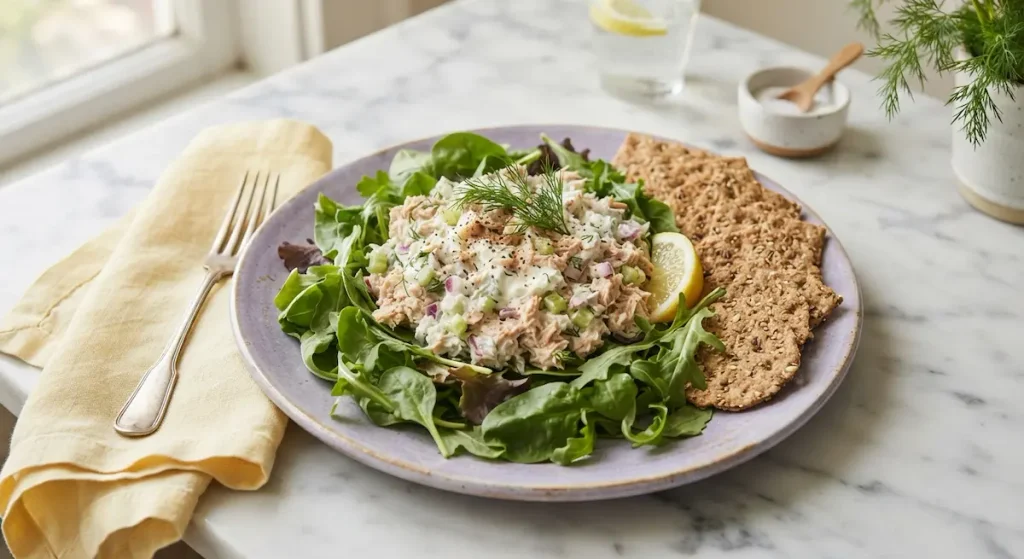
- Drain the tuna thoroughly — a few extra seconds pressing it against the can’s side makes a real difference in texture.
- In a mixing bowl, combine the tuna, Greek yogurt, celery, onion, lemon juice, and Dijon mustard.
- Fold everything together gently. You want the tuna to stay a little flaky, not mashed into a paste.
- Stir in the dill, if using, along with salt and pepper to taste.
- Chill for at least 15 minutes before serving — this lets the flavors settle and the texture firm up slightly.
- Serve over greens, in a whole-grain wrap, or straight from the bowl with crackers.
The ten-minute gut test: if you’re curious whether this actually feels different from a mayo-based version, try it side by side sometime — same lunch, two days, one with mayo and one with this tuna salad with Greek yogurt. Pay attention to how you feel in the hour or two that follows .
I’m not asking you to take my word for the gastric-emptying mechanism; I’m asking you to notice your own body’s response, which is honestly the more convincing evidence anyway.
Nutrition Facts (Per Serving — Makes 2 Servings)
| Nutrient | Amount |
| Calories | ~220 kcal |
| Protein | ~28 g |
| Carbohydrates | ~5 g |
| Fiber | ~1 g |
| Sugar | ~2 g |
| Sodium | ~450 mg |
Compare that to a traditional mayo-based tuna salad, which typically runs higher in calories and fat for the same amount of protein, largely because of how calorie-dense mayonnaise is by volume. The protein-to-calorie ratio here is part of what makes this tuna salad with Greek yogurt such a practical option if you’re trying to eat more protein without a corresponding jump in fat.
Which Diets and Goals This Fits
This recipe works well if you’re eating:
- High-protein — nearly 30 grams per serving
- Low-sugar
- Gut-friendly / probiotic-supportive
- Heart-healthy — meaningfully less saturated fat than the mayo-based version
- Diabetic-friendly — low carbohydrate and low glycemic load
- Low-sodium, if you use no-salt-added tuna and go light on added salt
One honest caveat: this isn’t automatically low-FODMAP as written, because of the onion. If you’re managing IBS and following a low-FODMAP approach, swap the red onion for the green tops of a scallion — you’ll keep the flavor without the fermentable carbohydrate load that raw onion carries.
Variations Worth Trying
For an Anti-Inflammatory Boost
Fold in a few slices of avocado or a small handful of chopped walnuts. Both add heart-healthy fats and a nice textural contrast — just know this does raise the overall fat content, so it’s a trade-off worth being aware of rather than a strictly “better” version.
For a Lower-FODMAP Version
Use scallion greens instead of red onion, and choose a lactose-free Greek yogurt if lactose is a known trigger for you. The result is still very much a tuna salad with Greek yogurt — just tuned for a more reactive gut.
Frequently Asked Questions
Is tuna salad with Greek yogurt actually good for digestion, or is that overhyping a simple swap?
It helps, but it’s not a cure-all. Lowering the fat load can ease the burden on a slow or sensitive stomach, and the live cultures in Greek yogurt may offer a modest boost to microbiome diversity. Individual gut sensitivity varies a lot, though — this is a genuinely helpful swap, not a guaranteed fix for any specific digestive condition.
Can I make tuna salad with Greek yogurt ahead of time?
Yes. It keeps similarly to a mayo-based version — USDA food safety guidelines generally recommend eating perishable salads like this within three to four days when kept refrigerated. Store it in an airtight container and stir well before serving.
Does tuna salad with Greek yogurt taste like the traditional version?
Close, but with its own character. Greek yogurt brings a slight tang that mayo doesn’t have, which is part of why the lemon juice and Dijon mustard are in the recipe — they round out that tanginess so the overall flavor still reads as “tuna salad,” just a fresher version of it.
Does tuna salad with Greek yogurt work if you’re lactose intolerant?
Often, yes, though it depends on the person. The straining process used to make Greek yogurt removes a good deal of the lactose found in regular yogurt or milk, which is why many people with mild lactose intolerance tolerate it reasonably well. If you’re more sensitive, a lactose-free Greek yogurt works just as well in this recipe.
A Quick Note Before You Dig In
This article is meant for general education, not personalized medical advice. If you’re managing a diagnosed digestive condition — reflux, IBS, gastroparesis, or anything else — please talk to your doctor or a registered dietitian before making significant changes to your diet. What works well for most people isn’t automatically the right call for your specific situation.
Conclusion
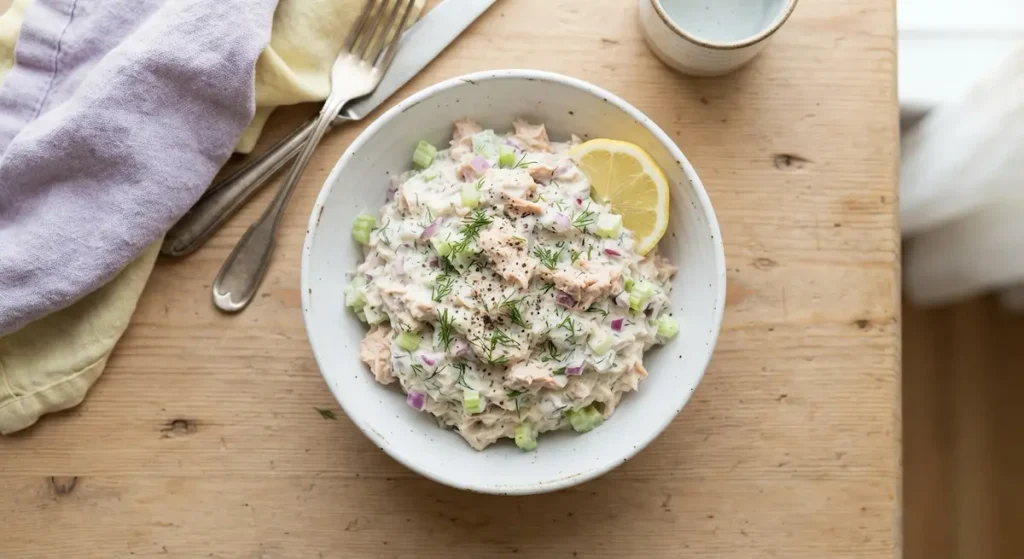
Your gut doesn’t care about willpower. It cares about workload. Every time you choose a meal that asks less of it — less fat to slow things down, a few live cultures to work in your favor — you’re doing something quietly useful, even if you never notice it directly. This tuna salad with Greek yogurt isn’t a dramatic health intervention. It’s a small, repeatable choice that happens to line up with how your digestive system actually works.
Try it once. Notice how you feel afterward. That’s really the whole pitch.
If this swap makes a difference for you, I’d genuinely love to hear about it — drop a comment below with how you tweaked it, or share it with the one friend who’s always asking you for lunch ideas that won’t leave them sluggish by 2 p.m. And if you want more recipes built around how your body actually digests them, the newsletter is the easiest way to catch the next one.
What Readers Think :
There are no reviews yet. Be the first one to write one.


